In Part I of this series, we discussed the evolution of stablecoin go-to-markets from shadow banking for startup exchanges to traders deploying into DeFi and now embedding stablecoins into traditional payment rails where businesses and consumers get paid.
So what’s next? Can a new stablecoin innovate on product (Part II) and how do you even enter a market that has turned into a duopoly (Part III)?1
In Part II, we will discuss the commoditization of the stablecoin tech, how automation will make yield universal, then review the history of bank features created by consumer regulation and highlight what features are next for stablecoins.
STABLECOIN TECH IS COMMODITIZED
Today there are over eighty USD-backed payment stablecoins and their underlying technology is all largely the same.2 The tech is so commoditized that you can launch a stablecoin in weeks per BitGo, a stablecoin-as-a-service provider that launched World Liberty Financial’s USD1 in short order.3
It was not always this way. When stablecoins first launched over a decade ago, issuers built every piece of their tech stack in-house. Tether first issued USDT in 2014 as a managed asset on the Omni Layer, a protocol built on top of Bitcoin, years before ERC-20 became the default token standard which stablecoins use today. Tether’s banking stack, famously hard to follow, required lots of bank shopping and legal engineering, to put it lightly. By the time Circle launched with USDC, they only had to deal with one bank partner while building out their own tech for tokenization, compliance, reserves, and the rest of the stack. Today stablecoin-as-a-service platform offers banking, compliance, tokenization, reserve management, audits, and custody all bundled into one offering.
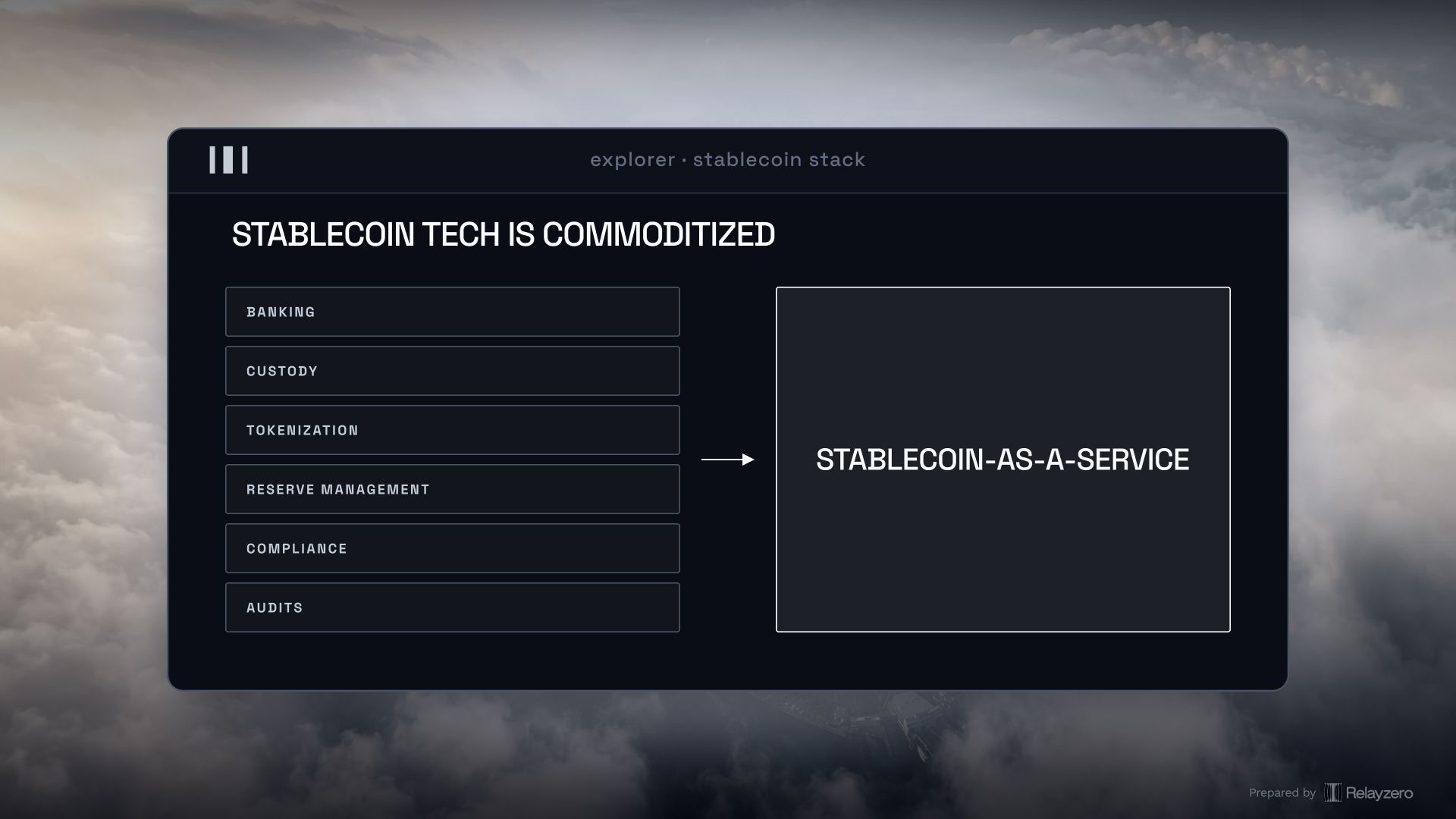
The introduction of the GENIUS Act turned these tools and features into requirements of what the Act calls “payment stablecoins”.4
AUTOMATION WILL MAKE YIELD UNIVERSAL
Yield will not be a differentiator for stablecoins and traditional finance largely due to automation, not regulation.
Earning interest, the key feature not only excluded from, but also explicitly prohibited by the GENIUS Act, became the topic of debate between incumbent banks and the crypto industry. While drafts of the CLARITY Act attempted to close the “rewards” loophole for stablecoins offering bonus cash to depositors holding stablecoins, Congress decided it was better to keep taking checks from the crypto and banking industries for the midterms instead of settling.
Coinbase began paying USDC holders rewards as early as 2019, but Paxos’s Global Dollar Network was the first to open reserve rewards to any partner willing to join. Today most stablecoins share reserve revenue with partners, who pass some of that revenue to depositors as rewards.5 The reserve yield shared with depositors largely depends on the partner negotiations with the issuer, whether the partner’s fiat payments flow through the issuer, and the partner’s marketing team’s budget to buy customers with above-market yield programs.67
Stripe’s recent launch of OUSD all but ensures the majority of the reserve revenue will be shared with partners, something Circle will likely mirror with USDC as competition for the U.S. markets heats up. Tether on the other hand, is rumored to offer minimal to no revenue sharing with most of its partners and depositors.
Native yield for depositors is essentially non-existent, a huge miss for an industry built on open-source, decentralized guarantees only blockchain technology can provide. The tool for empowering the internet of finance and anyone around the world has been neutered almost beyond recognition.
One has to wonder, can stablecoins and neobanks continue to compete against incumbent banks and fintechs?
Relayzero’s research suggests yes, but not on yield, because the yield gap is about to close for everyone with automation.

Everyone from banks and fintechs to stablecoin issuers, neobanks, and wallets will offer yield. How the yield is generated under the hood and shared will vary but the customers won’t know the difference. How? Automation.
“We’ll just auto-convert our stablecoins to our [to-be-released] tokenized deposits.”
- Sales Director, Big Business Banking at [FINTECH-REDACTED]
Banks will offer yield onchain via tokenized deposit accounts as the safest tokenized asset with passive yield. Startup banks and the “too big to fail” banks alike will allow customers to tokenize their deposits to attract new clients and stop customer flight. Tokenized deposit holders will be able to earn native yield and spend tokenized deposits with other KYC’ed bank customers.8
Many fintechs already let customers use payment stablecoins like USDC or their own branded stablecoins. Smart treasury programs will auto-convert “just-in-time” from the fintech’s interest-bearing tokenized deposits to payment stablecoins all powered by each fintech’s newly created OCC-charter bank.
“Everyone is just going to implement rewards programs.”
- Director of Earn Product at [EXCHANGE-REDACTED]
The market has already pushed stablecoin issuers to share yield with partner exchanges and other startups. Each will pass yield to depositors via reward programs that require some level of activity.9 Customers will enjoy the dopamine hit of each reward for their in-app views, clicks, and other activity akin to new-age credit card points programs.
“We’re automating the investing.”
- Founder and CTO at [DEFI PROTOCOL AND WALLET-REDACTED]
Neobanks and wallets will continue to offer yield-bearing vaults and other DeFi investment strategies in addition to stablecoin rewards. Historically, customers decided where to deposit their funds into DeFi. Automated investing tailored to each depositor’s investment strategy will take over decision-making in “smart wallets” where new-age wallet infrastructure, AI, vaults, and decentralized protocols collide. While DeFi yield carries different risks than rewards and tokenized deposit accounts, the customer does not know the difference nor care in most instances.
This leads us to the question: How can new and established stablecoins differentiate themselves and compete against the rush of banks and fintechs entering the market?
The history of bank accounts, prepaid cards, banking-as-a-service, and other fintechs is insightful here.
BANKING FEATURES CREATED BY CONSUMER REGULATION
Every banking product since the bank account started with one feature and eventually bundled more consumer-oriented features, many of which were required by law. Deposit insurance and the 60-day transaction dispute window are hallmark features created by consumer banking regulation in the U.S.
Deposit Insurance
Consumer bank deposits were not insured against bankruptcy until a string of banks failed and Congress created the FDIC to cover deposits starting in 1934.10 When pooled “for benefit of” bank accounts were first created for prepaid debit card programs, each customer’s deposits were not explicitly covered by FDIC insurance until a 2008 FDIC opinion clarified that the bank or the program operator could keep a subledger enabling pass-through insurance. Fintechs and banking-as-a-service providers are a different story.
Bankruptcy-remote fintech deposits are something Lawson Bae, President and Founder of Relayzero, intimately understands. As part of the Founding Team and the original General Counsel of Synapse, it became clear to Lawson that the fintech’s deposits were at risk of ledger issues and technology failures only open, verifiable blockchain ledgers could mitigate.11 Bae left Synapse to go full-time in crypto in 2018, largely due to the ledger guarantees only possible with blockchain tech. Six years later the fintech’s and its bank partner’s, Evolve Bank’s, ledgers both failed, resulting in a multi-million dollar shortfall and subsequent bankruptcy of Synapse.12 While regulators attempted to implement new rules after the Synapse collapse, the fundamental banking flaw is the technology not being openly auditable by third parties and cryptographically secured like blockchains.13
Transaction Disputes
Prior to 1978, consumers did not have a legal right to contest electronic transactions sent by mistake or fraudulently. Regulation E required banks to generally deliver monthly bank statements and gave consumers 60-days to contest any transactions sent by mistake or due to fraud.14 Pre-paid cards eventually were regulated into providing similar features to customers.15 At launch, many fintechs like Venmo did not give consumers bank statements. Today, most provide digital statements and must reimburse unauthorized transfers under Reg E, but when consumers are tricked into sending a payment themselves, any refund is left to the fintech’s terms of service, not a regulated consumer right.16
Bank account privacy was largely a byproduct of closed ledgers until the Right to Financial Privacy Act (1978) and the Gramm-Leach-Bliley Act (1999) made it a legal obligation. Yield followed the opposite path: the Banking Act of 1933 banned interest on checking accounts (Regulation Q), and that ban stood until Dodd-Frank repealed it in 2011. Sound familiar? The GENIUS Act’s yield prohibition on payment stablecoins is history rhyming.
The pattern repeats with every new form factor. What changes is how long consumers wait for the same protections and features that just make sense.
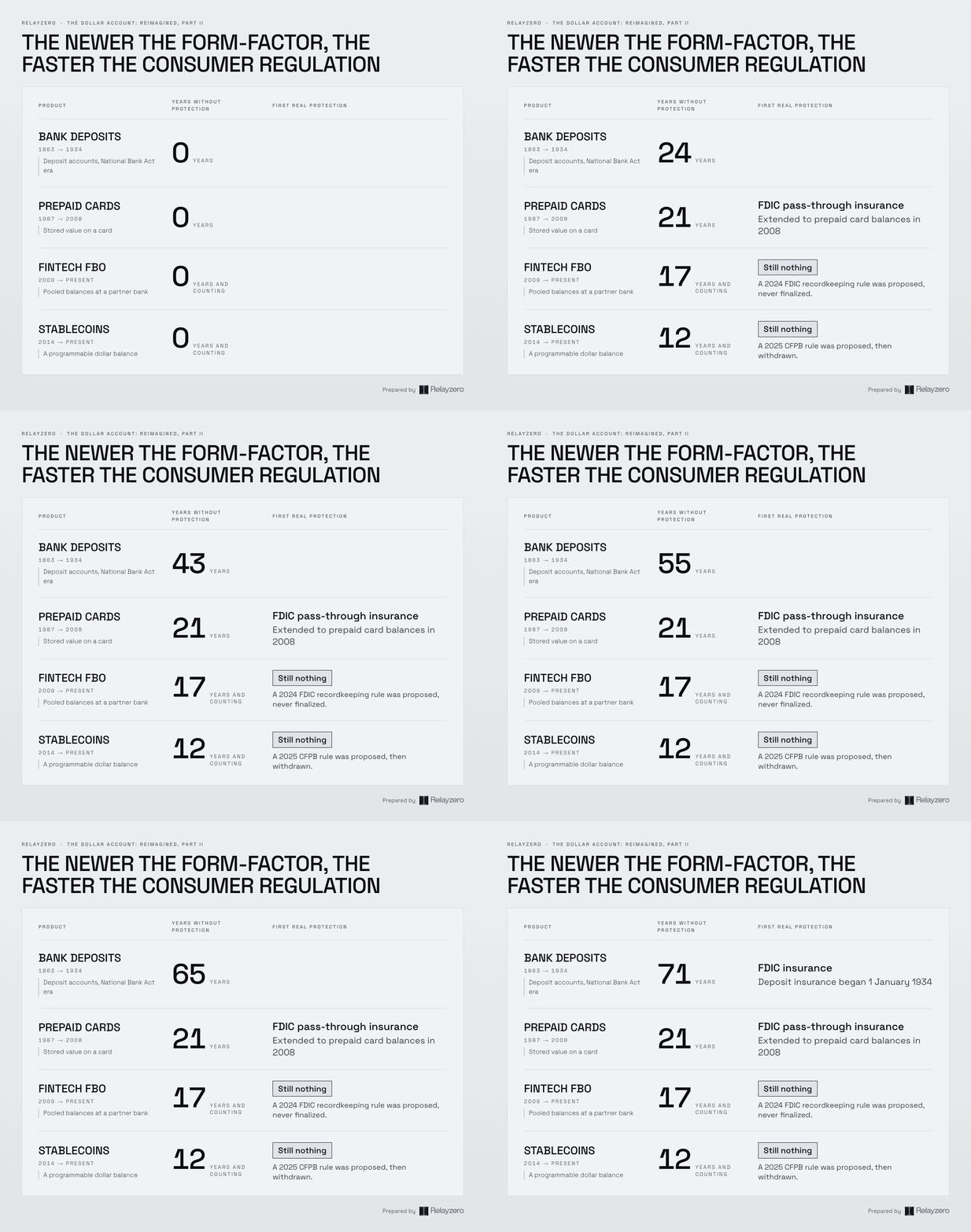
From a historical view, the older the form factor, the more consumer protections it offers, but newer technology has not closed the gap much faster. Protections generally arrive after something breaks:
- Consumer bank account (DDA) holders have had FDIC insurance since 1934, unauthorized transfer protection through Reg E, error resolution and a 60-day dispute window among other regulations for consumer protection that came much later.
- Prepaid card programs started in the late 1980s but did not have pass-through FDIC insurance until 2008, error resolution and fee disclosure rules until 2019.
- Fintech started in the 2010s and still lacks explicit regulation for consumer protection despite draft regulation being proposed after the Synapse collapse in 2024.
- Finally, stablecoins have been around since 2014 and it took the GENIUS Act 11 years to introduce some consumer protection but not the features seen in banking.
Every iteration of a “thing that looks like a bank account” started off operating in the Wild West before being regulated into something consumers could trust largely due to regulatory negotiations. Today, stablecoins are still in need of many of these consumer features which we believe the industry is best served creating itself, no regulation required.
What Features are Next For Stablecoins
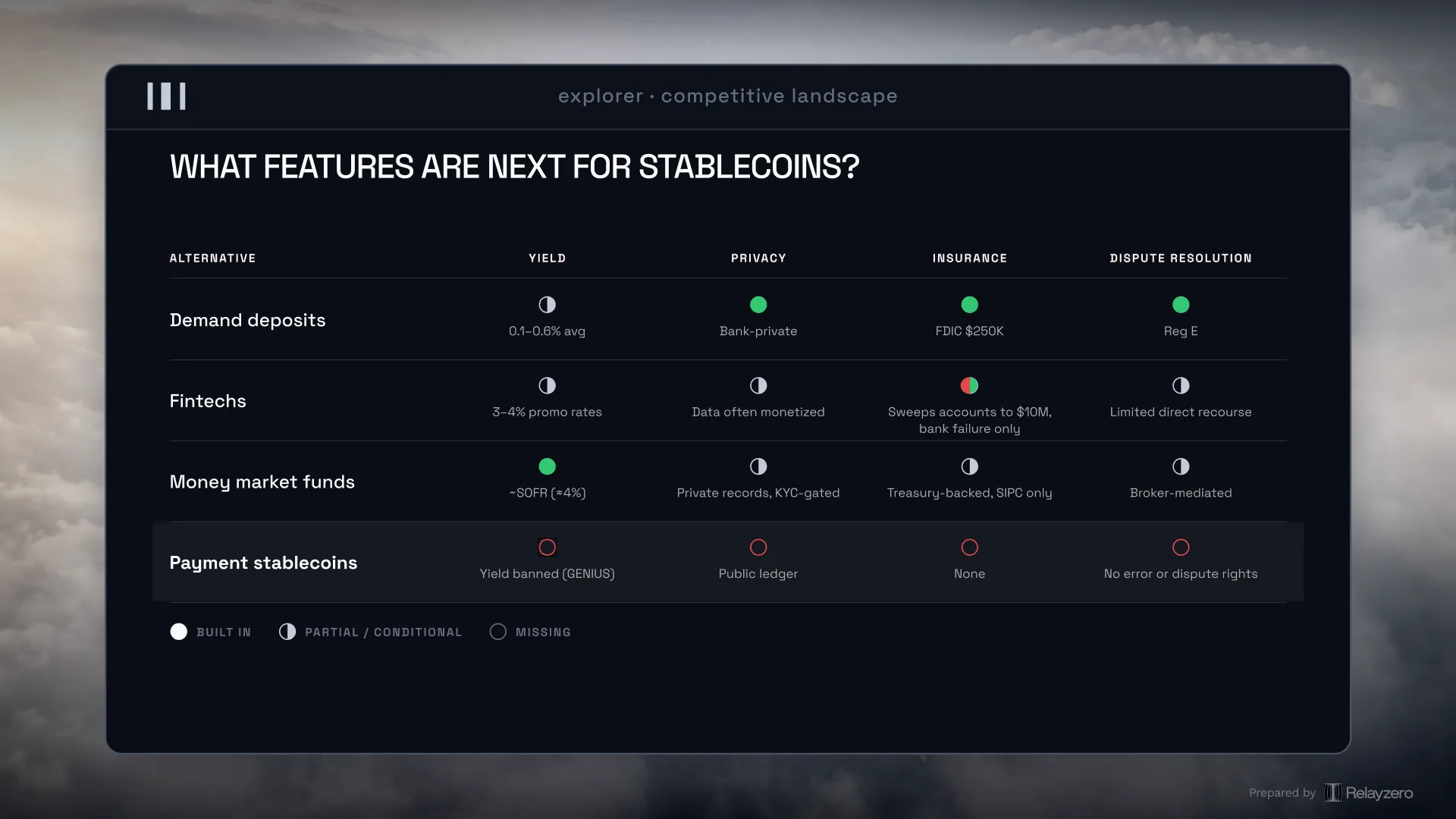
Stablecoins are the end state of bank account unbundling. It’s time for stablecoins to re-bundle consumer banking primitives: (i) passive yield, (ii) privacy, (iii) insurance, and (iv) dispute resolution.
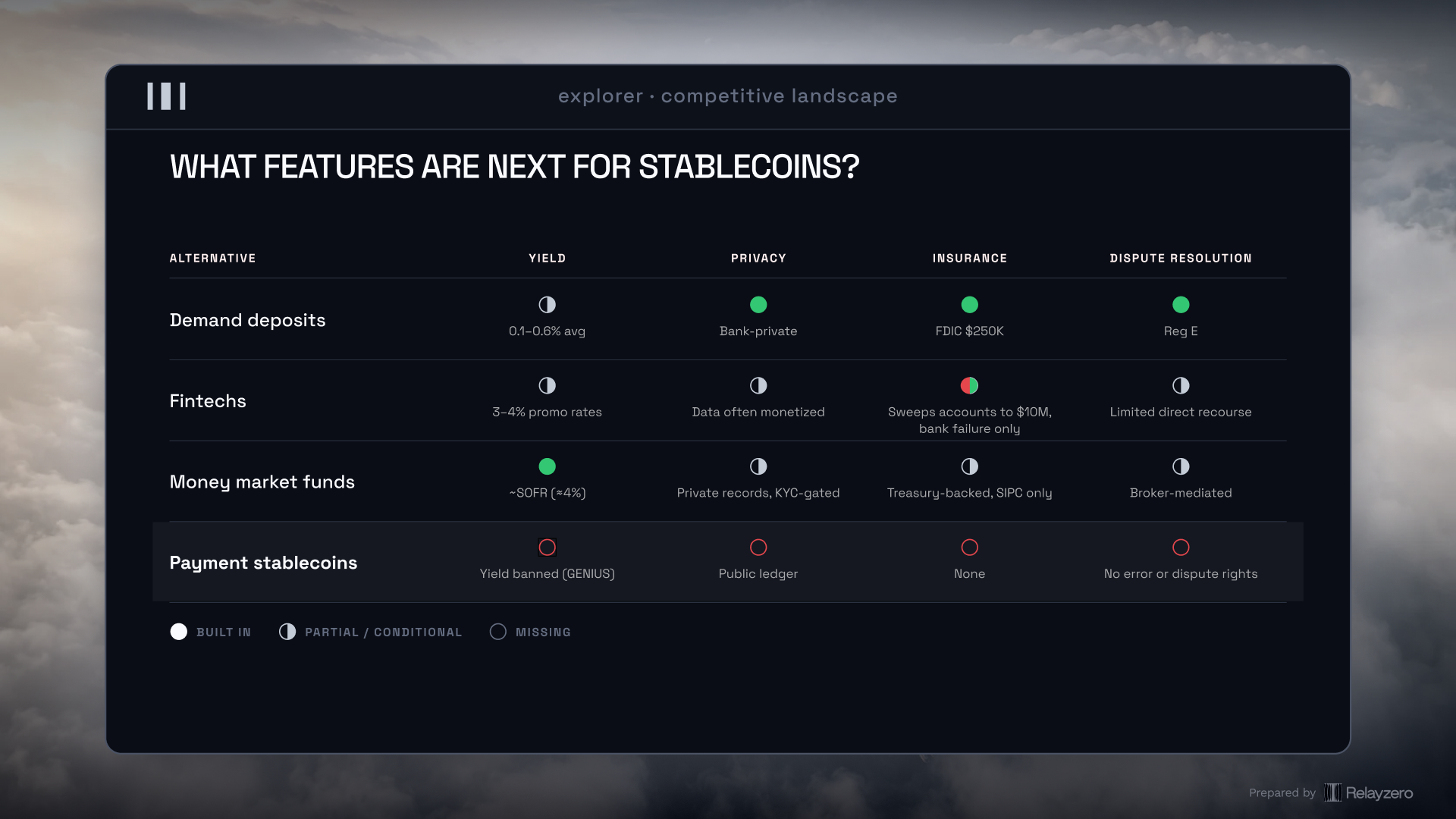
Not only do they lack many customer-friendly features of a bank account, depositors are also legally not customers of the stablecoin issuer due to regulation, and broadly have little to no contractual protections.17 Similarly, regulation prevents passive yield for payment stablecoins, however, creative product structuring is possible and referenced in the next part of this series of articles.18
While it’d be easy to say regulators should fix these problems, Relayzero argues the technology can provide solutions faster and better than regulators.19
Passive Yield
As discussed in the Automation Will Make Yield Universal section above, automation will effectively make yield passive even if the underlying assets lack native, passive yield.
Yield won’t differentiate stablecoins, but no stablecoin can compete without it. It is table stakes, like a checking account with no fees. The opening for stablecoins is not whether depositors earn yield, but who controls the yield distribution. Today yield is a reward handed out at a partner’s discretion, and onchain it can be a depositor’s right.
Tokenized bank deposits provide passive yield but they are not transferable to non-customers of the bank without KYC. While automated movement between tokenized deposit accounts and payment stablecoins is possible it adds costs and friction. The SEC could enable tokenized money market funds to be traded pseudonymously with non-customers otherwise impossible today with Transfer Agent rules. However, this is unlikely absent creative legal structuring similar to the tokenized stock products offered by Robinhood and Coinbase.20
Regardless of the underlying structure, passive yield is coming and will be rather ubiquitous. Securing the yield onchain as a depositor right is the next step.
Privacy by Default
“I’ve had more people pitch me privacy tools than customers have asked for privacy.”
- Head of Money Movement at [FINTECH-REDACTED]
The common sentiment is customers don’t want privacy. This is largely a function of lack of obvious solutions and the state of the technology.
Relayzero’s research suggests stablecoin issuers, their partners, and customers do not care about privacy until you mention one word: payroll. When you pay your team in stablecoins on a public blockchain, every employee’s salary, bonus, and your company’s runway are one block explorer searching away for coworkers, competitors, and anyone else who’s curious. No business would accept a bank that published its payroll ledger, yet that’s the default stance for product managers today.
While privacy in banking is required by some regulation, banking privacy is already structurally designed into how the tech works. Bank and fintech databases are not open for all to see.21 Blockchains, as a technology, are the polar opposite of bank ledgers where every transaction is public by default unless it is a privacy-focused blockchain like Zcash or private DeFi protocol like 0xbow. Fintechs kicked off the anti-privacy boom with the introduction of social payments of Venmo and Cash App. Ethereum Name Service, address tagging by compliance companies, and social trading turned hard-to-follow-transactions into a clear social graph of money. AI is already accelerating this mapping for business intelligence tools. We are likely mere months away from AI mapping business and consumer fund flows in a viral app.
Largely, this has not been a problem for crypto as it’s been all fun and games for the first decade. Stablecoin go-to-market moving to embedded payment flows will force many into obfuscation methods (e.g. fresh addresses, pooling, and sweeping) but these largely are inferior to native privacy solutions.
Early secondary market tools like Tornado Cash provided great privacy, but were magnets for money laundering. Meanwhile, privacy-specific protocols like Zcash are ineffective due to their lack of distribution.
Privacy as a consumer solution needs to be baked in natively like encrypted web traffic in browsers. However, payment stablecoins, as centralized assets, must enforce money laundering laws. 0xbow has proven that privacy and compliance can co-exist natively in DeFi protocols by “blocking illicit actors to ensure pool integrity.”22
It’s each portion of the stack’s responsibility to implement privacy solutions from neobanks and wallets to stablecoins, DeFi, and the underlying blockchains. Upstart stablecoins and eventually incumbent stablecoins can and should implement protocol-level, compliance-forward, privacy solutions.
Native, Onchain Stablecoin Insurance
If Tether or Circle went bankrupt, USDT and USDC depositors would have no priority claim over other creditors of the business’s operations and no insurance backstop. Prior to the GENIUS Act, stablecoin issuers held assets on the balance sheet and, as a result, company creditors had similar claims on assets as depositors. This means anything from a partner dispute to an HR lawsuit had similar rights to underlying stablecoin reserves and other company assets. While the GENIUS Act requires a bankruptcy-remote setup for issuers, this does not go into effect until Jan 18th, 2027. While USDC intends to comply, stablecoins like Tether created separate tokens to comply with payment stablecoin laws (e.g., Tether’s USAT), and this does not cover all potential bankruptcy scenarios.
In addition to being bankruptcy-remote, the reserves are now regulated. Stablecoins were originally marketed as “dollar-backed” but it was not until recently that it became commonplace for assets to be openly invested in short-term Treasuries.23 The GENIUS Act codifies the reserve collateral requirements in addition to the need for an independent audit.
The missing feature for stablecoin credit risk where reserves are offchain but a ledger is onchain? Onchain insurance.
While reserve collateral requirements are safer than a traditional bank’s loan portfolio, the ledger is subject to similar risks we saw in the Synapse bankruptcy. Additionally, even short-term U.S. Treasuries are not completely risk-free: when yields rise, reserve assets can be worth less than par, and a wave of redemptions that forces early sales would lock in those losses.24 While stablecoin ledgers are more auditable than fintech ledgers, the reserves are not onchain and thus not necessarily in sync with the number of minted tokens.
A security vulnerability or inflation bug that mints unbacked tokens would leave holders with more tokens than redeemable assets, and every holder shares the shortfall.25 This creates technical risk on top of reserve risk, and no amount of Treasury collateral covers it.
Courts and traditional insurance are not equipped to address losses that occur in real time on supposedly final onchain settlements.
Centralized stablecoin issuers need onchain insurance pools via reserves funded by reserve yield and other revenue as an initial solution. Many DeFi protocols already have similar reserve pools to cover hacks and default risks. Open questions remain about whether the insurance should be applied pro-rata like most of DeFi or something similar to FDIC that focuses on the holder rather than per account insurance with each holder being insured up to $250,000. Governance and what events trigger insurance coverage are also open questions worth a deeper dive than this article warrants. The solution, however, is obvious. Payment stablecoins need to self-insure, onchain.26
Dispute Resolution
Blockchains do not have undo buttons but payment stablecoins do. As centralized assets, stablecoin issuers can and do regularly effectively undo supposedly confirmed, cryptographically secured transactions by freezing, burning, and minting new tokens at will with moderator privileges on smart contracts.
Largely, stablecoin issuers only undo transactions when a court tells them to or it is to the stablecoin issuer’s financial benefit. Circle and Tether continue to avoid stepping in to stop stolen stablecoins from moving until a court authorizes them in many cases when it’s too late.27 While a DeFi protocol can afford to take stablecoin issuers to court, the cost of a court order is prohibitive for most depositors, especially when you consider the cost relative to the transaction size in dispute.
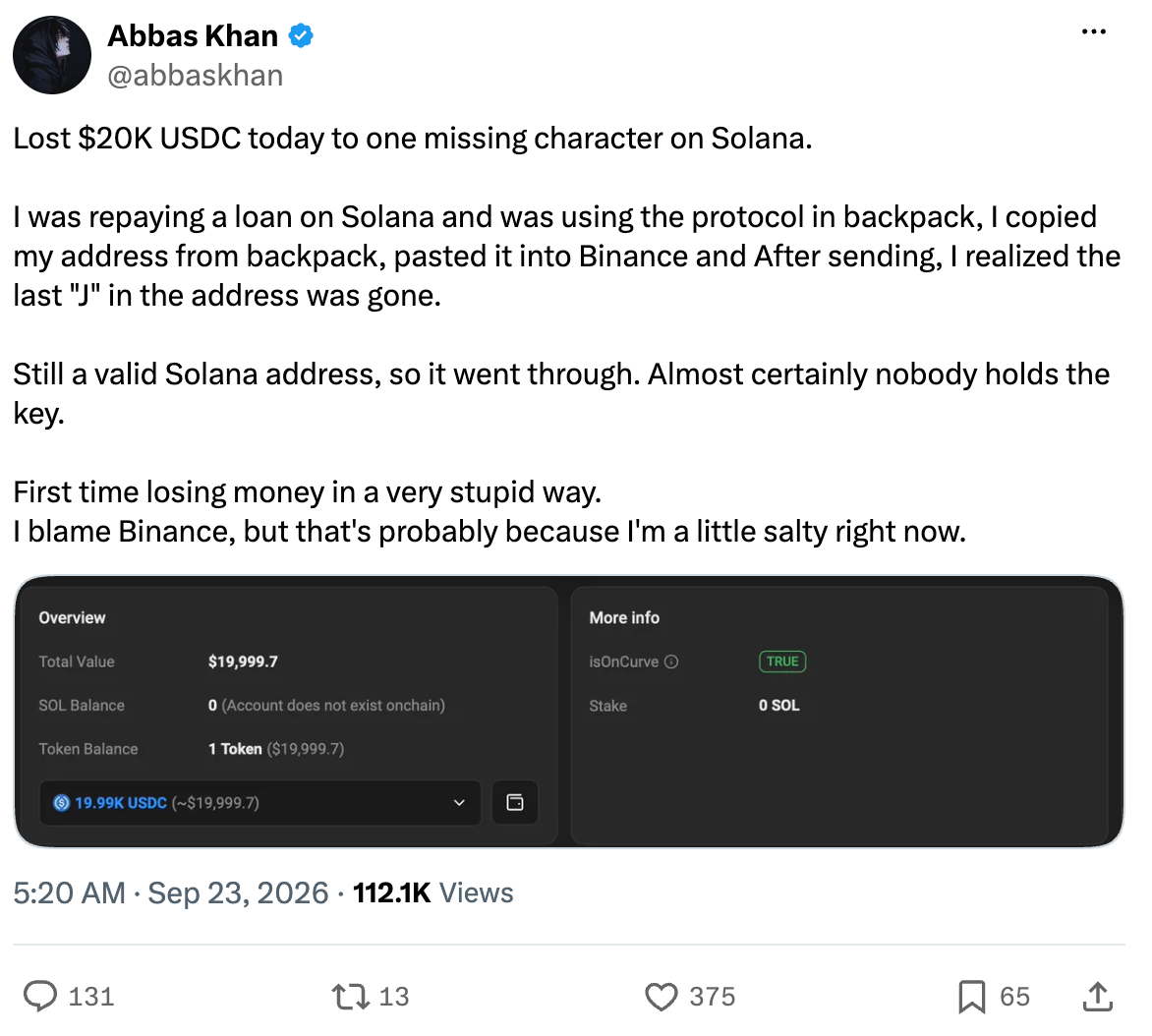
New and experienced stablecoin depositors make mistakes. From sending stablecoins to the 0x000… address and the token contract to fat-fingering the wrong address, mistakes happen all the time. In most cases, this is presumably pure profit to stablecoin issuers.
It’s obvious that courts cost too much time and money to solve problems at the speed of technology.
Instead of refusing to reply to tweets for help, stablecoin issuers can implement dispute resolution into their protocol. Stablecoins need basic customer support today for these issues. In the near future, AI can handle many customer mistakes without much creative structuring, as well. Complex mistakes, hacks, and disputes need more novel solutions. A council of AI agents serving as fact-finders, judge, and jury can handle complex problems at the necessary speed.28 Coupled with AI agents built into wallets to watch and quickly request dispute resolution, stablecoins can create an undo button while also preserving close-to-the-same finality of settlement we see today onchain without needing a full 60-day dispute window.
History Rhymes
Stablecoins have added tremendous value for consumers and depositors as a whole. However, history suggests that there are still a number of features left to build to improve banking for a world full of consumers and depositors. Yield is a step in the right direction but privacy, native insurance, and dispute resolution are necessary features for the future. Startup stablecoin issuers are likely the first to adopt. But how do they enter a market that looks all but closed off to new entrants?
That’s what’s next in Part III of The Dollar Account Reimagined, where we dive into open lanes for stablecoin go-to-markets.
Notes
- 1.Stripe’s OUSD is the best attempt yet to disrupt the duopoly. Having launched Sept 30th, 2026 it ended the day with $454.3M making it the 19th largest stablecoin according to DefiLlama and 18th on CoinMarketCap
- 2.DefiLlama, Stablecoins dashboard, accessed Oct 4, 2026. https://defillama.com/stablecoins
- 3.BitGo, "USD1: The Blueprint for BitGo's Stablecoin-as-a-Service." https://www.bitgo.com/resources/blog/usd1-the-blueprint-for-bitgos-stablecoin-as-a-service/
- 4.Features is a generous term given none of these features live onchain and customers do not financially benefit from stablecoins being cheaper to operate. Until recently, the stablecoin had no intrinsic value beyond how it was used. Interest was the missing feature and holy grail.
- 5.Paxos, "Introducing Global Dollar Network," Nov 4th, 2024 — the network "will return virtually all rewards to participants and is open for anyone to join," contrasted against stablecoins that "retain all the reserve economics." https://www.paxos.com/newsroom/introducing-global-dollar-network-an-open-network-to-accelerate-and-reward-global-stablecoin-adoption-driven-by-anchorage-digital-bullish-galaxy-digital-kraken-nuvei-paxos-and-robinhood — Compare CoinDesk, "Coinbase to Pay Users 1.25% Interest on USDC Stablecoin Holdings," Oct 2nd, 2019. https://coindesk.com/markets/2019/10/02/coinbase-to-pay-users-125-interest-on-usdc-stablecoin-holdings/
- 6.For example, Circle is rumored to be offering a minority share of reserve revenue with partners using third-party minters and double the share if you move your fund flow and stablecoin minting to Circle’s ecosystem. The difference is a direct result of Circle’s original sin, agreeing to split 50% of all revenue with Coinbase unless directly distributed through Coinbase or Circle where 100% of the revenue is retained by the minting party.
- 7.Buying customers with high yield historically has low retention rates when marketing programs end or otherwise become uncompetitive. For example, DeFi yield-farmers famously whipped deposits around in search of the highest yield offering. Relayzero’s internal research suggests the same is true for reward and earn programs.
- 8.N3XT bank is already offering tokenized deposit accounts - https://n3xt.io/digital-dollar and JPMorgan Chase is testing similar - https://www.wsj.com/finance/banking/jpmorgan-citi-and-big-banks-plan-new-tokenized-deposit-system-to-answer-crypto-6b2d696b
- 9.The CLARITY Act prevented passive yield and broadly required some amount of “activity” for passing yield along as rewards.
- 10.The Federal Deposit Insurance Corporation was created in 1933 during the economic turmoil of the Great Depression in order to maintain stability and public confidence in the nation’s financial system - https://www.fdic.gov/90years
- 11.For example, an account ledger built in Python, a popular programming language that, like many languages, has nuanced issues with floating-point math, could produce small rounding errors only visible at scale. While this type of bug is not what caused the Synapse and Evolve Bank ledgers to fail, it's a good example of the risks of software ledgers in traditional finance. Blockchain technology does not necessarily prevent these types of software bugs, but it at least makes them openly auditable by others.
- 12.While media reports focused on Synapse’s ledger issues, reporters and regulators failed to identify issues with the Evolve Bank’s ledger, the one responsible for transferring funds within the bank’s ledger which mirrored balances in addition to executing deposits and withdrawals. While this is largely a result of reporting by media who lack basic understanding of how fintech and bank core technologies work, this is a clear mistake by bank regulators.
- 13.Regulators proposed the rule of Recordkeeping for custodial accounts (after the Synapse collapse), which still remains proposed as of 2026 - FDIC, "Recordkeeping for Custodial Accounts," Notice of Proposed Rulemaking, 89 Fed. Reg. (Oct 2nd, 2024), RIN 3064-AG07. Comment period extended to Jan 16th, 2025; not finalized as of October 2026. http://www.federalregister.gov/documents/2024/10/02/2024-22565/recordkeeping-for-custodial-accounts
- 14.Electronic Fund Transfer Act (1978), implemented by Regulation E. Periodic statements: a statement for each monthly cycle in which an electronic fund transfer occurred, at least quarterly if none. Error resolution: notice timely within 60-days of the statement on which the error first appears; the institution determines within 10 business days, may extend to 45 calendar days only if it provisionally credits the disputed amount within 10, and corrects within 1 business day. Fees were required to be disclosed, as well, while it took another 13 years for the Truth in Savings Act to require disclosures relating to how interest was shared with depositors - https://www.ecfr.gov/current/title-12/chapter-X/part-1005; https://www.law.cornell.edu/uscode/text/12/chapter-44.
- 15.Prepaid cards were retrofitted into Reg E with monthly statements being required for prepaid cards with credit or overdraft features, and a 60-day dispute resolution window for prepaid card holders - https://www.ecfr.gov/current/title-12/chapter-X/part-1005/subpart-A/section-1005.18
- 16.Regulation E defines an "unauthorized electronic fund transfer" as one "initiated by a person other than the consumer without actual authority to initiate the transfer and from which the consumer receives no benefit." Error-resolution duties attach only to an "error" as defined at § 1005.11(a)(1). A transfer the consumer was deceived into initiating is therefore neither unauthorized nor an error, and carries no statutory remedy. The CFPB voluntarily dismissed its suit against Zelle operator Early Warning Services, filed December 2024 over induced fraud, with prejudice on 4 March 2025. New York's Attorney General then sued under state law in August 2025, and that case largely survived a motion to dismiss on July 20, 2026. https://www.ecfr.gov/current/title-12/chapter-X/part-1005
- 17.Regulators do not consider secondary-market holders of payment stablecoins as “customers” under Anti-Money Laundering (AML) and Know Your Customer (KYC) laws. While this enables pseudonymous transfers, a key feature necessary for DeFi operations and banking the world, the lack of legal relationship with stablecoin issuer prevents secondary market holders from receiving protection.
- 18.Think: tokenized money market funds meet pseudonymous transfers of payment stablecoins.
- 19.While there are secondary market solutions for some of these problems (e.g. onchain insurance protocols), Relayzero believes these features should be available by default to all stablecoin depositors and the most secure solution is features native to each stablecoin’s smart contract and protocol. This can be further demonstrated by the history of consumer regulation and banking. Any consumer could probably have insured their bank account against bankruptcy on the secondary market but in practice none do. The best solutions are always default and native to the product.
- 20.Most creative legal structures we have seen remove basic investor rights similar to many tokenized stock assets removing voting and other common investor rights. As a result, Relayzero believes it is the SEC’s duty to investors to enable pseudonymous transfers.
- 21.A Gramm-Leach-Bliley Act privacy provisions, implemented by Regulation P - financial institutions must provide privacy notices, must observe limits on disclosing nonpublic personal information to nonaffiliated third parties, and must observe limits on redisclosure and reuse; an annual notice is required during a continuing customer relationship, and account numbers may not be disclosed to nonaffiliated third parties for marketing. See CFPB, Regulation P. https://www.consumerfinance.gov/rules-policy/regulations/1016/ and FDIC, Consumer Compliance Examination Manual, VIII-1. https://www.fdic.gov/consumer-compliance-examination-manual/viii-1-gramm-leach-bliley-act-privacy-consumer-financial
- 22.0xbow’s privacy-pool-core repository found at https://github.com/0xbow-io
- 23.“Every tether is always backed 1-to-1, by traditional currency held in our reserves. Aprl 10th, 2016. http://web.archive.org/web/20160410111434/https://tether.to/
- 24.Rising Treasury yields push down the market price of Treasuries already held in reserve. Holding to maturity avoids the loss, but redemption liquidity requirements can force sales before maturity, the same mechanism that sank Silicon Valley Bank in 2023.
- 25.On Oct 25th, 2025, Paxos mistakenly minted $300 trillion of PYUSD on Ethereum during an internal transfer, more than the entire U.S. national debt, before burning the excess within about 30 minutes. Paxos attributed it to a technical error, not a hack, but Aave paused PYUSD markets as a precaution. The Block, "Paxos mistakenly mints $300 trillion PYUSD on Ethereum, citing tech error," October 2025. https://www.theblock.co/post/374870/paxos-mistakenly-mints-300-trillion
- 26.FWIW, enterprising stablecoin issuers could also sell additional insurance on top of default coverage.
- 27.Hackers tend to quickly swap funds into fiat via exchanges, more decentralized cryptocurrencies, or hide funds in privacy protocols - each case making recovering lost funds very difficult.
- 28.There are already a few legal crypto tech startups working on embedding rights, more expressive smart contracts, and AI-powered enforcement.
Newsletter
Doing the work
Notes on how crypto deals actually get done. Written by the people running them, published when there is something worth saying.